
Today, we are looking at the basics of Therapeutic Reflexology as a reminder of this amazing therapy that you may want to consider adding to your busy lifestyle in an attempt to keep your stress levels under control and increasing your overall wellbeing.
In South Africa, Therapeutic Reflexology is seen as an official healthcare profession formally regulated by a statutory council, namely the Allied Health Professions Council of South Africa (AHPCSA) alongside other healthcare modalities like Aromatherapy, Ayurveda, Chinese Medicine and Acupuncture, Chiropractic, Homeopathy, Naturopathy, Osteopathy, Phytotherapy, Reflexology, Therapeutic Aromatherapy, Therapeutic Massage Therapy, and Unani-Tibb (AHPCSA, 2021). Formal regulation by the AHPCSA provides the profession of Therapeutic Reflexology with professional healthcare status, making it illegal to practice the profession in South Africa without being registered with the AHPCSA. To register with the AHPCSA, a formal 2-year Diploma in Therapeutic Reflexology from a South African Qualifications Authority (SAQA)-accredited training institution, recognised as such by the AHPCSA, is required that includes at least 200 hours of practical community service training hours. The reason for statutory council regulation of healthcare professions is mainly to protect the public by ensuring high-quality healthcare services from properly qualified healthcare providers.
AHPCSA registration is not optional; to practice Therapeutic Reflexology in South Africa, AHPCSA is mandatory and without such registration, the person is practicing illegally. You will not go to a Medical Doctor that practices illegally, so do not support such Therapeutic Reflexologists either; you deserve only the best. AHPCSA is compulsory, but association membership, on top of AHPCSA registration, is voluntary and merely there for the Therapeutic Reflexologist to be part of a community of other healthcare providers. There are numerous national associations [The South African Reflexology Society (TSARS), and The National Reflexology Association (TNRA)] and international associations available, but please note that registration with these organisations does not give the Therapeutic Reflexologist the right to legally practice in South Africa; for that, AHPCSA registration is required.
Therapeutic Reflexology is a formal healthcare profession in South Africa and therefore many medical schemes pay for Therapeutic Reflexology treatment sessions. The payment or reimbursement from medical schemes depends on the medical aid option or plan the patient is on and it is usually paid from the savings account portion. Therapeutic Reflexology is a healthcare expense and thus deductible from annual income tax; if you are on medical aid, all such invoices will be indicated as such on your annual medical aid statement.
Therapeutic Reflexology is a therapy and not a diagnostic profession and therefore the Therapeutic Reflexologist will not diagnose any condition nor be a fortune teller telling you what is wrong with you. During a Therapeutic Reflexology session, the Therapeutic Reflexologist will do a proper healthcare assessment and based on the assessment, will provide treatment.
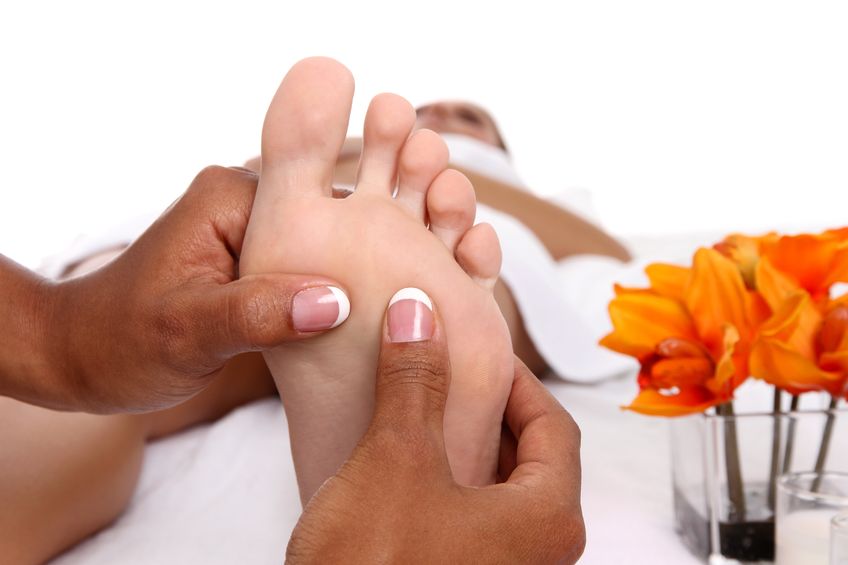
Therapeutic Reflexology works on the nerve endings (or reflexes) on the feet, but also sometimes other body parts like the hands, face, and ears. It is a non-invasive therapy, and the patient does not have to get undressed for treatment, only the shoes and socks are removed, making it the ideal therapy for any person of any age, ethnicity, or gender.
What you can expect during the session is that the Therapeutic Reflexologist will provide specific pressure on your feet (or other body parts). Some of the reflexes may be sensitive, but it is crucial to tell the Therapeutic Reflexologist about this, as it provides valuable feedback to the therapist, but simultaneously helps the therapist to provide you with the best possible treatment; the idea is not to cause you pain, but instead, the session should be enjoyable while increasing your overall relaxation. The Therapeutic Reflexologist may ask you some questions, but during the actual therapy, you may speak to the therapist or you may choose to rather lie back and relax without speaking; your preference will be providing the tone of the session. During the first session, many patients may have lots of questions, but during follow-up sessions when you are more familiar with what is happening, you may choose to rather just lie back and relax while leaving your feet in the capable hands of the Therapeutic Reflexologist. The ultimate goal of Therapeutic Reflexology is to help you relax.
Many patients may want to know how many sessions will be needed, but that is a difficult question to answer as each person reacts differently to Therapeutic Reflexology. It should also be noted that Therapeutic Reflexology does not treat specific conditions, but instead work to increase overall wellbeing and in the process of doing so, many symptoms may be alleviated, but that is dependent on how each person’s body reacts to treatment. It is usually said that if it took you 10 years of living an unhealthy lifestyle to end up with a specific condition, do not expect it to disappear within one treatment session; that is not realistic. You may have to give Therapeutic Reflexology a fair chance so you may have to get a few sessions before seeing if it will work for you or not. At the private practice of Christo Scheepers Therapeutic Reflexologist, I use the Vacuflex Concepts electronic reflexology device in conjunction with physical stimulation of the reflexes and it usually increases the effectiveness and many of my patients experience improved quality of life or alleviation of symptoms from the first session, but for others, it may take a few sessions. If no results are seen, the Therapeutic Reflexologist will discuss this with the patient and may make a referral to another healthcare provider; the integrity of the Therapeutic Reflexologist is crucial in this instance as continued Therapeutic Reflexology without any results is not fair on the patient; at the private practice of Christo Scheepers Therapeutic Reflexologist, high levels of integrity are maintained at all times.
The cost of Therapeutic Reflexology sessions may vary from therapist to therapist, but at the private practice of Christo Scheepers Therapeutic Reflexologist medical aid rates apply because that is seen as the recommended rate for Therapeutic Reflexology treatment sessions that is a fair price for good quality treatment.
Therapeutic Reflexology is a healthcare profession and just like physiotherapy or any other healthcare profession, there are no guarantees of success, but you have to ensure that you get the best possible Therapeutic Reflexology treatment to increase your chances of success.
What potential patients should do?
- Ensure the Therapeutic Reflexologist is properly qualified – ask to see qualifications
- Ensure the Therapeutic Reflexologist is registered with the AHPCSA – ask to see the official AHPCSA registration certificate accompanied by proof of payment of the current year
- Ensure the Therapeutic Reflexologist has a valid practice number issued by the Board of Healthcare Funders (BHF), the same organisation that issue practice numbers for Medical Doctors, if you want medical aid reimbursement – ask to see the practice number
- If you are on a medical scheme and would like the medical aid to reimburse the Therapeutic Reflexology sessions, please contact your medical aid prior to treatment to ensure that your medical aid plan/option covers Therapeutic Reflexology treatments (properly qualified and registered Therapeutic Reflexologists will provide proper paperwork containing practice number, ICD-10 codes and Therapeutic Reflexology procedure codes that are required for medical aid reimbursement).
You deserve the best possible Therapeutic Reflexology treatment, so do not be deceived by somebody claiming to do reflexology without complying with the basic requirements of practicing the profession legally within South Africa. Never be afraid to ask the Therapeutic Reflexologist about qualifications, AHPCSA registration status, practice number availability, experience, or anything else relating to the profession; a truly properly qualified, registered, and formally regulated healthcare provider will never feel offended by such questions.
Make your appointment today with a fully qualified and registered Therapeutic Reflexologist.
References
AHPCSA (2021) AHPCSA Website. [Online] Available from http://www.achpsa.co.za [Accessed 4 October 2021).
—
Christo A. Scheepers: Therapeutic Reflexologist
Dip.T.R.(Cum Laude) [IARAMT]
AHPCSA: A11945
Pr. No.: 1080000737453
Tel. 072-800 7243