Therapeutic reflexology is a complementary healthcare modality that holistically treat the human body. In today’s post we’ll explore this holistic modality, especially in the psychological dimension, to understand where it can be used effectively.
Psychological Holism
The human beings are holistic in nature and consists of seven distinct dimensions, namely the physical, psychological (emotional), spiritual, social, sexual, financial and career dimensions (Scheepers, 2003; Scheepers, 2007). Therapeutic Reflexology is able to address all seven these dimensions and therefore it can be seen as a truly holistic healthcare modality.
Today our focus will be on the psychological dimension; that human dimension characterised by your emotions, will and intellect.
* Intellect
The intellect refers to the mind; your thinking dimension. Every human being has the ability to think, to consider the pros and cons and then to make decisions based on logic or your intellectual ability. Often people need to make decisions, but emotions may prevent them from making the decision and then they procrastinate and the result is a continuous thought process where they begin to think in circles without concluding. This makes the decision even more difficult.
Just think what happened when you were indecisive of a career choice or where to relocate to or whom to marry or maybe not to marry, but to remain single. These decisions usually tend to make you think along the lines of one option, but then you begin to consider the other options and because no decision is made, then you begin to think in circles and the one day you lean towards the one option, but the very next day towards another option. The problem with indecisiveness is that is keeps your mind so busy that you begin to use unnecessary energy to keep your mind occupied, instead of using the energy to relieve your stress; the end result, you feel very stressed.
* Will
Your will is that part of you where you want to do something with or sometimes you do not want to do something; the will is that area of decision making that is usually based on a combination of your intellect and your emotions. Every person has a free will and nobody can force you to make any decision that you do not really want to make.
You may know for example that Therapeutic Reflexology is good for you, but if you do not want to go for a therapeutic reflexology session, nobody can overrule your will. You need to want to go for therapeutic reflexology, before you will use your free will to voluntarily make such an appointment. It is often said that if a person addicted to a substance does not want to become free from the addiction, no amount of treatment will help. It is a matter of the will of a person.
* Emotions
Every person has numerous emotions and it is not something you can touch, but it is a feeling that you experience that are sometimes based on circumstances of life, but other times it is experienced without any specific reason. You may feel happy because you have received a gift, but other times you may feel happy without having received a gift. Sometimes you feel grief due to the loss of a loved one, but at other times you may feel “down” without any specific reason.
Emotions are what makes us human and often people make decisions based on how they feel at a specific moment in time and when their emotions change, they may feel that they have made the wrong decision.
* Psychological and Physical Holism
In the previous post we have discussed the fact that your body is holistic and physically interconnected with the various bodily systems, organs and tissues. Today it is not strange to understand that psychologically you are also a holistic being with an interconnectedness between your emotions, intellect and will that can cause you to base decision making on a combination of these psychological aspects.
What is more fascinating, is the fact that holism does not separate the body, the mind and the emotions; in other words, the physical and psychological dimensions are not separated from each other, but fully interconnected as well.
Let’s consider this through an example. You have been diagnosed with a physical illness and because you wake up and do not feel well, you tend to feel emotionally “down” or even depressed. The physical illness thus leads to your emotions being affected, but the opposite is also true. If you feel depressed for a long time, it may actually lead to you developing physical signs, symptoms and even illness conditions; here the emotions have affected the physical body.
Therapeutic Reflexology and the Psychological Dimension
Therapeutic Reflexologists are not psychologists or counsellors, but they do work with emotions from a therapeutic reflexology perspective and with their scope of practice as established by the Allied Health Professions Council of South Africa (AHPCSA), the statutory regulating body for therapeutic reflexology in South Africa.
Therapeutic reflexologists are trained in the Five Element Theory and Traditional Chinese Medicine theory and in various alternative theories where emotions are linked to the physical body. Sometimes the therapeutic reflexologist may pick up an imbalance in specific reflexes (nerve endings), but the patient may not have any relating physical symptoms and then it is valuable to see if there may be any emotions linked to the appreciated imbalance.
It is not a strange concept in Western medicine either, just think about what happens when you are really stressed after sitting in front of the computer for a time. You usually end up with stiff muscles in your shoulders, neck and you may even have resulting tension headaches. It is not a strange concept that stress is stored in specific muscles. So, various emotions may be linked to specific areas of the body.
Personally, I have worked with many people that have experienced trauma in their past and who did not want to talk about the trauma at all. During a normal therapeutic reflexology session, the person may begin to cry as the emotions just flows out.
How does that happen, you may ask? We did not talk about the trauma! We did not do any form of counselling! The patient merely relaxed while I performed a therapeutic reflexology session! The answer is easy: All emotions are stored physically in the body and often such an imbalance can be determined with the use of therapeutic reflexology and by stimulating those specific reflexes on the feet, the body does not only release the stress and tension, but also the relating emotion.
Therapeutic reflexology is an amazing complementary healthcare modality for people to receive in conjunction with the treatment they receive from a registered counsellor or psychologist; the two modalities complement each other, it does not work against each other and therefore it is really beneficial for patients.
Psychological Benefits
Booth (2003), Brown (1999:49), Dougans (2005:35), Kunz and Kunz (2016:140-141) and Scheepers (2007) indicate that reflexology is especially useful when treating the following conditions:
- Anxiety;
- Emotional disorders;
- Emotional turmoil;
- Emotional upset;
- Fear;
- Indecisiveness;
- Pain;
- Phobias;
- Releasing emotions like anger, joy, fear, grief, worry, sympathy and needs;
- Stress and related disorders;
- Trauma; and
- Traumatic Experiences.
Emotional Reflexology
Therapeutic Reflexology does not treat a specific conditions or illness, but instead helps the body to relax and heal itself, or at least attempt to balance itself, from the inside out. It is not the therapeutic reflexology that causes healing, but the body itself.
Therapeutic reflexology just helps the body to relax, reduce stress, eliminate toxins, balance hormones, increase blood circulation and secretes chemicals like endorphins that assists the body to heal or balance itself and, in the process, it relieves symptoms and increases a feeling of overall wellbeing. The body responds with reduced signs and symptoms of discomfort or pain and increased wellness. This is done by physically stimulating the reflexes or nerve endings on the feet and sometimes on other areas of the body like the hands, face and ears.
A result of therapeutic reflexology treatment is that emotions are released and balanced. It is a good add-on for counselling or psychotherapy as it does not interfere with the psychological process, but helps the body to relax and increase a feeling of wellness.
Sometimes you need to relax and help yourself to destress while your emotions can be at peace and your mind relaxed to the point where it is cleared of the indecisiveness so you may make the correct decisions.
Touch
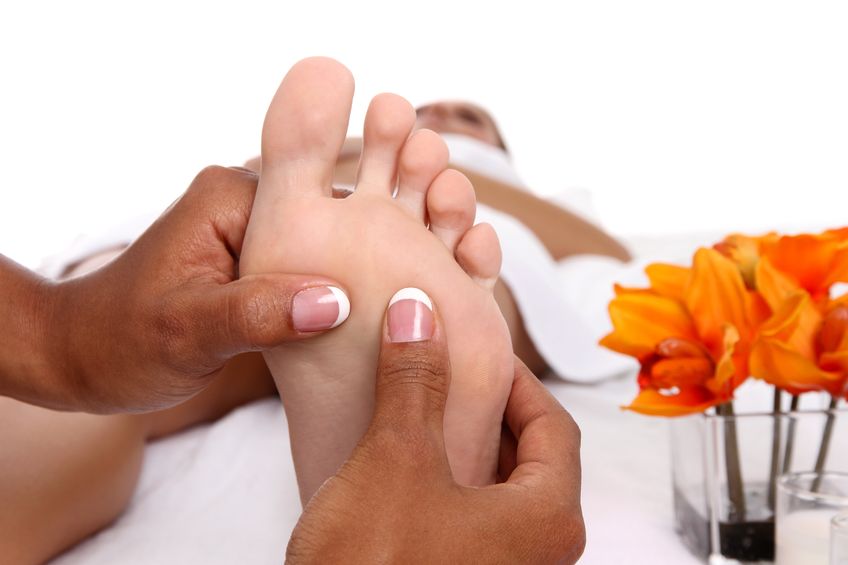
Therapeutic reflexology is more than just a healthcare modality to help you eliminate signs and symptoms; it is a therapy and that means that it is accompanied by therapeutic touch.
Therapeutic reflexology offers a non-invasive way of touch (on your feet) that may help you to relax and as a result you may experience a sense of wellbeing while the body balances your emotions. Booth (2003) says that reflexology offers one of the best forms of touch known to mankind and that before somebody experiences reflexological touch, they may feel that they have never been touched before.
Therapeutic reflexology offers a non-invasive way of therapeutic touch that will help you to feel connected while you relax and allow your body to enhance your physical and emotional health.
References
Booth, L. (2003)Vertical Reflexology: A revolutionary five-minute technique to transform your health. London: Piatkus.
Brown, E. (1999)Alternative Medicine: A step-by-step guide. Bath, UK: Mustard.
Dougans, I. (2005) Reflexology: The 5 elements and their 12 meridians – a unique approach. London: Thorsons.
Kunz, B. and Kunz, K. (2016) Reflexology: Health at your fingertips. 2ndEdition. London: Dorling Kindersley.
Scheepers, C.A. (2003) The Exploitation of Practical Sociology as Counselling Model for Application in a Christian-Holistic Founded Practice. Unpublished Ph.D.-thesis. Kempton Park: Commonwealth Open University.
Scheepers, C.A. (2007) Holistic Wellness: A Christian Omnibus for Whole-Person Wellbeing. Lincoln, NE: iUniverse.
—
Christo A. Scheepers: Therapeutic Reflexologist
Dip.T.R.(Cum Laude) [IARAMT]
AHPCSA: A11945
Pr. No.: 1080000737453
Tel. 072-800 7243