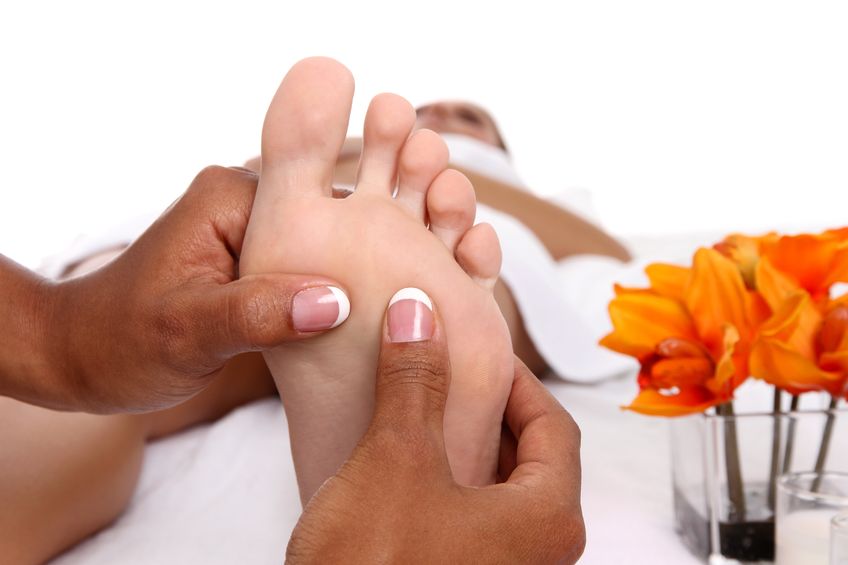
Therapeutic reflexology is a complementary healthcare modality that holistically treat the human body. In today’s post we’ll explore this holistic modality, especially in the spiritual dimension, to understand where it can be used effectively. This post will not follow the usual New Age approach often linked to the field of complementary medicine.
Spiritual Holism
The human beings are holistic in nature and consists of seven distinct dimensions, namely the physical, psychological (emotional), spiritual, social, sexual, financial and career dimensions (Scheepers, 2003; Scheepers, 2007). Therapeutic Reflexology is able to address all seven these dimensions and therefore it can be seen as a truly holistic healthcare modality.
Today our focus will be on the spiritual dimension; that human dimension characterised by your longing to worship and be connected with a Higher Power. Who this Higher Power is, is determined by your own spiritual beliefs, but allow me to share my thoughts on this fascinating human dimension.
In the realm of Complementary and Alternative Medicine (CAM), there is a large following of those believing in the New Age spirituality approach, but this post is not based on New Age principles, because I do not adhere to that approach as I personally see it as an approach contradicting its own basic principles. Let me explain:
A New Age approach basically accepts all kinds of spirituality and all forms of deity under the premise of inclusivity, yet always while rejecting Christianity and Jesus Christ. The mere fact that Christianity and Jesus Christ are excluded from this approach, indicates to me that it is not such an inclusive approach as its followers want to portray. When mentioning Christianity or Jesus Christ in meetings where the New Age approach is followed, it is almost as if every person in the room gets offended and then rejects the person who dared to mention an alternative approach. Here, I am speaking out of personal experience.
This post is therefore not written from the usual New Age approach to articles of this nature, but instead it is written from a Therapeutic Reflexology perspective which is a scientific approach to a healthcare modality. As a Therapeutic Reflexologist with my own beliefs, I’ll share my beliefs on the spiritual dimension with you, but that does not affect the therapeutic reflexology treatment in any way.
A good Therapeutic Reflexologist will never try to force their own spiritual beliefs onto the patient, but instead will always work with patients within their point of reference. When lifestyle advice is provided during a consultation, it is therefore based on the patient’s perspectives and will not be based on the therapist’s spiritual point of reference. An example is that the therapeutic reflexologist will not tell a patient to destress themselves by making use of meditation if the patient is spiritually opposed to meditation.
Beware of any reflexologist trying to oppose his or her beliefs onto you as the patient; chances are good that such a therapist is not properly qualified or formally registered and regulated by the Allied Health Professions Council of South Africa (AHPCSA).
My Spiritual Beliefs
Any healthcare practitioner or therapist have their own spiritual beliefs, it is not any different for therapeutic reflexologists. Personally, I prescribe to the Christian faith and I’ll share with you what that belief entails, why that is my belief system and how it impacts on my therapeutic approach.
* What does Christianity entail
I do not always like to be associated with “Christianity” as such, because many wrong and negative things have been done in the past and ascribed to Christianity. In Christianity there are various streams with vast differences between the different factions or denominations. Instead, I like to rather call myself a Born-Again Believer instead of a Christian.
As a born-again believer in Jesus Christ, I believe that the Bible is the Word of God and I believe in the God as portrayed in the Bible as the Higher Power to be worshipped. As human beings, we are all imperfect and sinful, but God made us acceptable through the sacrifice of His Son, Jesus Christ, that died on a cross on our behalves. As a result of this sacrifice, His believers are given two commands: Firstly, to love God and thus to pursue a living relationship (not religion) with Him and secondly, to love all people; that means to not discriminate against any person based on their age, gender, religion, race, sexual orientation or cultural background. Love all people literally means just that, to love and respect ALL people and to treat ALL people with dignity and respect.
* Why do I believe in Christianity
I grew up in a Christian home, but as Louis Malherbe used to say, just because you grew up in a garage, does not make you a car. When I was in standard three, I had a personal encounter with God and realised that I needed Him in order to change my life for the better and I gave my heart to Him. Thereafter I attempted to live a good life pleasing to Him, but years later I realised that my attempts on being good, was all based on religion and not on relationship.
In January 1999 I made the decision to give my whole life to God, meaning that as of that day I would pursue a living relationship with Him instead of trying to please Him based on religious do’s and don’ts. It changed my life and I experienced God supernaturally during that year and years to follow to such an extent that nobody will ever be able to convince me that there is not a God. I know He exists and that He is alive as He supernaturally touched and even healed me.
* How does Christianity affect my therapeutic approach
My beliefs do not directly affect my therapeutic approach as therapeutic reflexologist, but it does indirectly affect it. Directly, therapeutic reflexology is based on scientific principles being applied, but indirectly, my beliefs direct the way I treat people and thus positively influence my bedside manner.
As a born-again believer, I believe in treating all people with dignity and respect while appreciating each person as an individual. This speaks to the holistic nature of therapeutic reflexology, because the holistic approach is a customised approach for each individual. It is also aligned with the Biblical view portrayed in 1 Thessalonians 5:23 that people are holistic beings consisting of spirit, soul and body; speaking of the spiritual dimension, the psychological dimension and the physical dimension.
Spiritual Benefits
Therapeutic reflexology is not a spiritual form of treatment, it is a scientific healthcare modality and therefore it cannot be seen as directly influencing spirituality.
In the previous two posts we have discussed the physical and psychological dimensions and as such we know that therapeutic reflexology can assist with physical conditions like stress, but also emotional conditions like anxiety, emotional matters, fears and trauma.
Often trauma and emotions like anxiety, fear, grief, worry and so forth may have a spiritual context as well and indirectly therapeutic reflexology will thus benefit the spiritual dimension by addressing the emotions.
A person that experienced a traumatic event often have spiritual questions that arise, for example: Where was God when I was assaulted?
During a therapeutic reflexology session, the patient has the opportunity to relax and feel the release of stress in all human dimensions; that includes stress reduction in the spiritual dimension. What does stress reduction in the spiritual dimension mean? It means that sometimes people experience stress due to spiritual questions that are unanswered and by taking some time off by getting a relaxing therapeutic reflexology session, it provides some relaxation and sometimes even clarity as a result of being relaxed and not under high stress levels.
The therapeutic reflexologist is a caring therapist and experiencing loving therapeutic touch in a non-invasive way as therapeutic reflexology offers, may also assist a patient to experience spiritual benefits in an unconscious way by realising they are not alone in the midst of their situation, but there are caring people around.
Do Therapeutic Reflexologists only work with patients of the same faith or religion?
No, definitely not. The therapeutic reflexologist will work with any person of any religion without ever discriminating against anyone.
Personally, I have worked with many patients from various religious backgrounds, beliefs, cultures, race, gender, age, sexual orientation and so forth, because my approach is never to place my beliefs on the patient, but to work with the patient within his or her frame of reference.
My beliefs just make it possible for me to love all patients and to treat everyone equally with dignity and respect regardless of any differences there may be between us based on age, beliefs, cultural background, gender, race, religion, sexual orientation or any other difference. Sociology has always been an interest for me as I value the differences in people and find it fascinating to learn from people and understand their various approaches to life and living.
Conclusion
Your spirituality will never exclude you from receiving the best possible therapeutic reflexology from a professional therapist that will not attempt to impose his beliefs on your life, but will treat you with respect and dignity.
References
Scheepers, C.A. (2003) The Exploitation of Practical Sociology as Counselling Model for Application in a Christian-Holistic Founded Practice. Unpublished Ph.D.-thesis. Kempton Park: Commonwealth Open University.
Scheepers, C.A. (2007) Holistic Wellness: A Christian Omnibus for Whole-Person Wellbeing. Lincoln, NE: iUniverse.
—
Christo A. Scheepers: Therapeutic Reflexologist
Dip.T.R.(Cum Laude) [IARAMT]
AHPCSA: A11945
Pr. No.: 1080000737453
Tel. 072-800 7243