Reflexology is often referred to as unscientific and a pseudoscience online and in some media outlets, but is this correct? In today’s post, we’ll consider the science or lack thereof in relation to Therapeutic Reflexology.
When speaking to certain conventional healthcare providers, they may discourage reflexology, or any form of complementary healthcare for that matter, due to there being “no scientific proof” for it. When speaking to other conventional healthcare providers, they encourage the use of reflexology and even refer patients for it. Why the difference?
We’ll consider it in today’s post, but I cannot write a post like this without immediately thinking about the past two years of COVID-19 where the media constantly said, “follow the science”, yet the very same media has been totally quiet when the “science” proofed to be wrong. Follow the science is a good phrase if you don’t use it to try and manipulate the masses because science is something that constantly evolves as new information and research come to light. Science is not stagnant but intends to be based on theories that are upheld until such time as better research may prove them incorrect. When Newton observed the existence of gravity, that theory became the science of gravity based on his observations, but it will only remain the relevant theory until somebody can prove a different theory; until now, nobody could so it is safe to say that gravity is probably a very sound theory. If the same principles were used during the past two years without trying to manipulate the phrase “follow the science”, then maybe we would not have seen all the loss of common logic and one-sided reporting in the mainstream media. However, let me leave it there and move over to reflexology.
Reflexology and complementary healthcare do not always have all the scientific evidence to back it up because research is often expensive and the main funders of medical research like the pharmaceutical companies are not always willing to fund such research. That is, however, no excuse. So, let’s briefly look at what healthcare research is.
Research is the collection of raw data through various means that are analysed and interpreted and then presented in a logical format. Medical research is often based on experimentation where there are different groups involved like the treatment group (or experimental group), the control group, and the comparison group. When such research is conducted and published, it is seen as very scientific because it is based on actual experiments that can be proved and duplicated. This very scientific approach to research is well-known within the medical disciplines, but not always within the field of complementary healthcare and reflexology, although, more and more such studies are being conducted and are becoming available for reflexology.
Experimental research is not the only form of research and there are many different forms of research that can be done. One such form of research is situated more within the fields of the social sciences, namely observational research which is usually more subjective in nature. That is where many of the reflexology studies are based because it is entrenched in the personal observations of reflexologists. That does not make the studies unscientific, just very biased as it is based on individual observations and opinions. So, why reflexology is often referred to as a pseudoscience, is because it cannot be proven through experimentation as it is based on some people’s observations, but just because something has been observed, does not make it unscientific, it merely makes it not objectively proven yet.
Let me give you an example. When a person is diagnosed with diabetes, it is usually accompanied by extreme thirst. That is based on observations of various medical doctors, but as far as I know, there has not been clear scientific evidence yet as to what is connecting the pancreas to the tongue to cause thirst; there is no direct line connecting the two. There are numerous theories on why the signs and symptoms appear, but no clear evidence. This is a form of research based on observation. It is not disregarded as being unscientific or pseudoscience because it is clearly observed to the point that extreme thirst is often seen as a possible symptom accompanying diabetes.
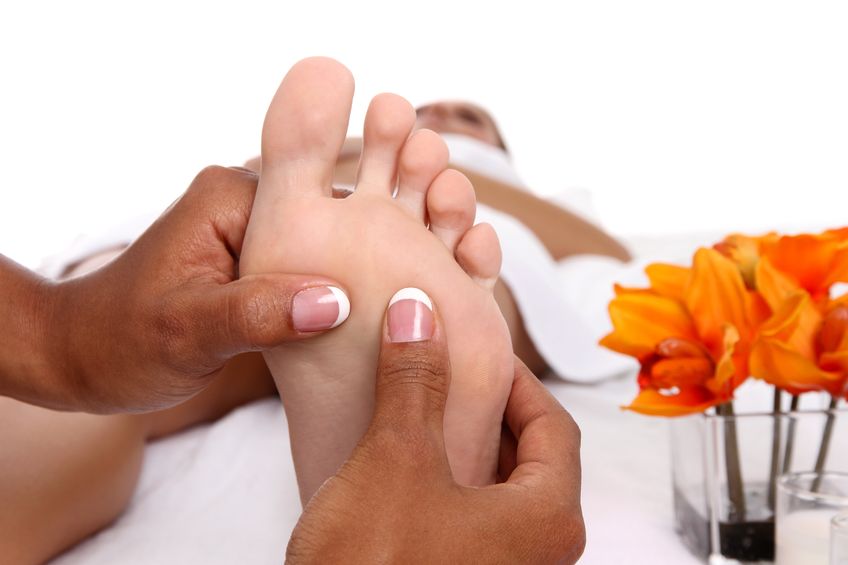
Similarly, many observations have been made over the years that when a person’s feet are stimulated, there are certain results following; one such clear result is the reduction in stress and the induction of relaxation. It may still need some more research, but the evidence is there already. Many aspects of Therapeutic Reflexology are based on evidence-based research but not yet on experimentally proven research, but that does not change the fact that there is evidence that Therapeutic Reflexology is beneficial in certain instances and that reflexology is an emerging healthcare discipline in need of more research.
There is more and more research being done about reflexology and if you would like to read some of the recent studies, you are welcome to read more at www.christoscheepers.co.za/research.
If you want to experience Therapeutic Reflexology for yourself, make your appointment today.
—
Christo A. Scheepers, Ph.D.
Therapeutic Reflexologist
AHPCSA: A11945
Pr. No.: 1080000737453
Tel. 072-800 7243
www.christoscheepers.co.za
info@christoscheepers.co.za